Honfleur Font: A Smart Choice for Small Business Embroidery
First Impression: Timeless, Refined, and Ready for Branding
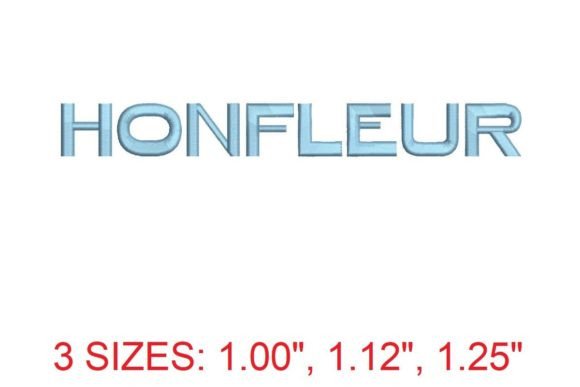
As an embroidery designer who’s digitized thousands of logos and fonts for small businesses—from neighborhood bakeries to indie florists—I immediately recognize Honfleur Font’s quiet confidence. The name evokes French coastal charm, and the description promises “impeccable stitch quality” and “timeless” results. That tells me this isn’t a trendy script or a heavy display font—it’s likely a clean, slightly elevated serif or transitional design with balanced proportions and open counters. For small business merch, that means instant credibility: friendly enough for a handmade studio, polished enough for a boutique café apron or a local pet brand’s embroidered tote bag.
Where Honfleur Font Shines in Real Business Use
Honfleur Font excels where clarity, consistency, and craftsmanship intersect—exactly what small businesses need when building recognizable, repeatable brand assets. Here’s how it performs across common applications:
- Embroidered patches: Its even stroke weight and moderate contrast translate beautifully into stitched form—no fragile serifs or thin connectors that vanish at 2–3 inches wide. Ideal for iron-on or sew-on patches on staff uniforms, backpacks, or product packaging accents.
- Apron embroidery & cap fronts: On curved surfaces like baseball caps or bib aprons, Honfleur Font’s letter spacing and x-height hold up well—no crowding or distortion when digitized correctly. It reads cleanly from 6 feet away, supporting both function (staff identification) and brand warmth.
- Tote bag design & custom apparel: Whether stitched on canvas totes, cotton tees, or linen napkins, Honfleur Font adds subtle sophistication without shouting. It pairs naturally with hand-drawn icons or minimalist logos—perfect for Etsy sellers and creative studios wanting to elevate their handmade product presentation.
- Back To School merch: While not overtly academic, its timeless tone works exceptionally well for school-run boutiques, teacher-led craft studios, or educational nonprofits launching branded merchandise. It avoids childish clichés while feeling approachable and inclusive.
- Commercial embroidery projects: As a digital embroidery file, Honfleur Font scales reliably across hoop sizes and fabric types—making it efficient for shops handling high-volume orders for local businesses or event merch.
Use With Intention: Where to Apply Caution
Even excellent fonts require thoughtful application. Honfleur Font is no exception. Here’s where I advise extra attention:
- Small patch sizes under 1.5 inches: Test stitch-out first—even refined fonts can lose legibility when condensed. Prioritize uppercase-only use or simplified wordmarks if scaling down.
- Dark uniforms or textured fabric: Review thread color contrast carefully. A soft ecru or charcoal thread may mute Honfleur Font’s definition on heavy twill or fleece. Opt for matte polyester or rayon threads with strong sheen contrast.
- Frequent-wash items (e.g., staff work shirts): Avoid ultra-thin strokes or tight kerning that increase stitch density unnecessarily—this can lead to puckering or thread wear over time. Confirm the embroidery file uses optimized underlay and appropriate jump stitch placement.
- Curved cap fronts or sleeve cuffs: Always run a test on the actual fabric and stabilizer combo. Even well-proportioned fonts can distort without proper hooping technique and stabilizer pairing.
How Honfleur Font Strengthens Your Brand Identity
For small businesses, every embroidered detail contributes to perceived value—and Honfleur Font delivers on multiple levels. Its “timeless” quality builds trust: customers subconsciously associate clean, balanced typography with professionalism and care. Unlike overly decorative fonts that date quickly, Honfleur Font supports long-term visual consistency across your design assets—whether it’s the chest logo on a barista’s apron, the tagline on a floral shop’s reusable tote, or the boutique name stitched inside a handmade scarf.
It also enhances buyer engagement. When shoppers see Honfleur Font on a product, they read intention—not just decoration. That elevates your handmade product from “cute” to “curated.” And because it works equally well on physical goods and printable mockups, it streamlines client approvals and marketing visuals—keeping your commercial embroidery workflow lean and confident.
Practical Designer Notes Before You Stitch
Before committing Honfleur Font to your next small business merch project, follow these field-tested steps:
- Test it in black and white first—eliminate color bias and assess true contrast and balance.
- Check legibility at your smallest intended patch size—stitch a sample before digitizing full production files.
- Review thread color contrast on your target fabric—especially for dark or textured materials.
- Inspect letter spacing and kerning—tight settings may cause thread buildup; generous spacing ensures breathability in stitch density.
- Confirm hoop size compatibility—some versions may be optimized for specific hoops; verify before batch digitizing.
- Test on real fabric with your preferred stabilizer—different weights and weaves impact stitch definition significantly.
- Create a printable mockup for client approval—show how Honfleur Font integrates with existing logos or brand colors.
- Compare it beside other design assets—does it harmonize with your iconography, packaging, and web typography?
- Confirm commercial licensing—since you’re using it for small business merch, ensure the digital embroidery file permits resale and branded product use.
Final Thought: A Quiet Investment in Professional Presence
Honfleur Font isn’t flashy—but that’s its strength. In a crowded marketplace of small business merch, it offers quiet authority, consistent execution, and scalable elegance. Whether you’re embroidering for a neighborhood florist’s delivery totes or a Back To School pop-up shop’s staff caps, Honfleur Font helps your clients stand out through refinement, not noise. As an embroidery designer, I recommend it not as a trend, but as a tool—one that grows more valuable the longer it lives on garments, patches, and products your customers truly love.